
Incentive travel has evolved far beyond being a simple reward or a luxury perk. Today, it is recognized as one of the most powerful tools organizations can use to drive performance, strengthen loyalty, and inspire long-term behavioral change. Yet, despite its proven impact, one critical question continues to surface in boardrooms and executive meetings around the world: How do we measure the return on investment of incentive travel programs?
Unlike traditional incentives such as cash bonuses or merchandise, incentive travel delivers value on multiple levels, financial, emotional, cultural, and strategic. This multidimensional impact is precisely what makes incentive travel so effective, but also what makes ROI measurement more complex. Measuring ROI in incentive travel requires a shift in mindset: from focusing solely on cost versus revenue, to understanding total program value and long-term business outcomes.
This article explores how organizations can measure ROI in incentive travel programs in a meaningful, credible, and strategic way, one that resonates with executives, aligns with corporate goals, and justifies continued investment.
Why ROI Matters More Than Ever in Incentive Travel
In an era of increased financial scrutiny, transparency, and accountability, incentive travel programs are no longer immune to budget evaluations. Senior leaders want to know not only what the company is spending, but why and what it delivers in return. Incentive travel must therefore be positioned as a business investment rather than an expense.
At the same time, workforce dynamics have changed dramatically. Motivation, retention, and engagement are now among the most pressing challenges organizations face. Incentive travel sits at the intersection of performance and experience, making it uniquely suited to address these challenges, if its value can be clearly demonstrated.
ROI matters because it provides the language executives understand. It transforms stories into insights, experiences into outcomes, and emotions into strategic data.
Redefining ROI: Moving Beyond Financial Returns
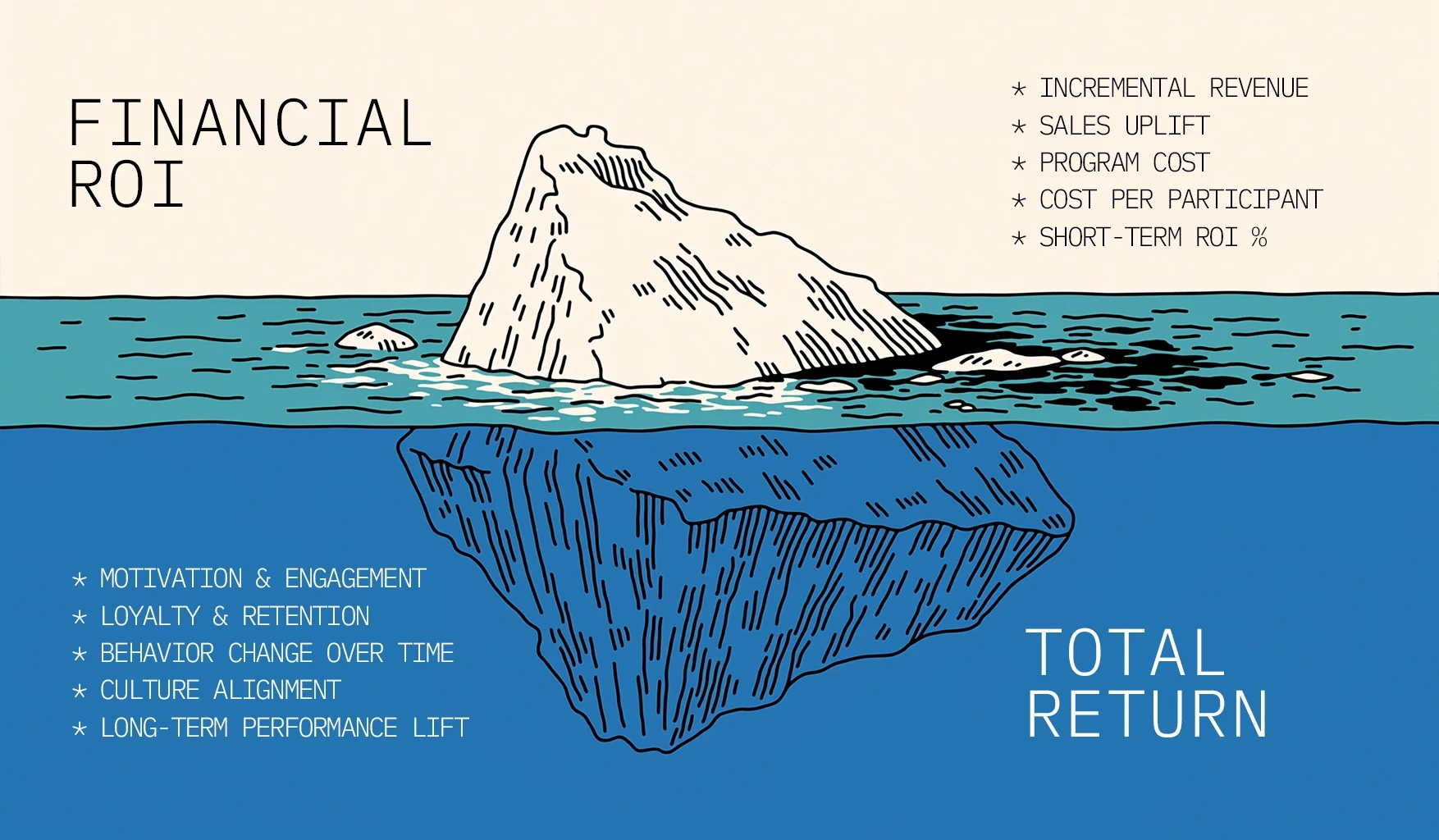
Traditional ROI calculations focus on simple formulas: revenue generated minus cost, divided by cost. While this approach can be useful, it only captures a fraction of what incentive travel actually delivers.
In incentive travel, ROI should be understood as total return, encompassing both tangible and intangible benefits. Financial performance is essential, but it does not exist in isolation. Motivation, engagement, loyalty, and cultural alignment are often the real drivers behind sustained performance improvement.
Organizations that succeed in measuring incentive travel ROI recognize that value appears across three dimensions: immediate financial impact, medium-term behavioral change, and long-term organizational benefit. Each of these layers must be considered to obtain a complete picture of success.
The Importance of Setting Clear Objectives from the Start
Measuring ROI begins long before the first flight is booked or the destination is announced. The foundation of any successful measurement strategy lies in clearly defined objectives that are directly aligned with business priorities.
An incentive travel program without specific objectives is nearly impossible to evaluate. Goals must be established early, communicated clearly, and agreed upon by key stakeholders. These objectives serve as the benchmark against which success will be measured.
At this stage, organizations must ask critical questions. What behaviors are we trying to influence? What performance gaps are we addressing? What outcomes would justify this investment? When incentive travel objectives are directly linked to measurable business indicators, ROI becomes significantly easier to track and defend.
Establishing Baselines and Performance Benchmarks
Once objectives are defined, it is essential to establish baseline metrics. These baselines represent the “before” picture and provide a reference point for comparison after the program concludes.
Baselines may include historical sales data, engagement scores, retention rates, or performance benchmarks by region, team, or individual. Without this context, it becomes difficult to determine whether changes observed after the program are truly attributable to the incentive travel experience.
Baseline data transforms anecdotal success into evidence-based conclusions. It also enables organizations to isolate the incremental impact of the incentive program, rather than relying on assumptions or perceptions.
Core Metrics for Measuring Incentive Travel ROI
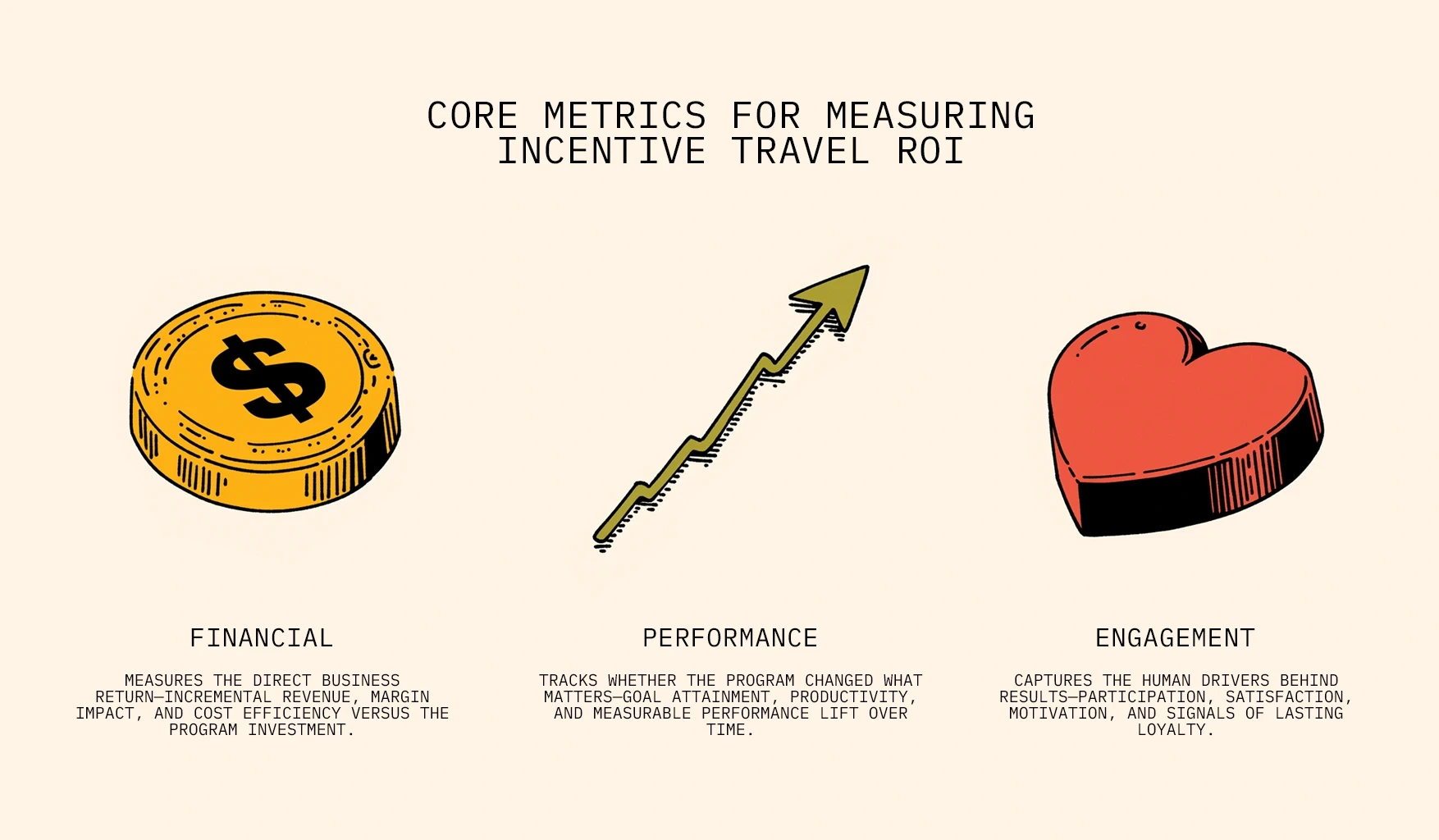
Effective ROI measurement relies on a combination of financial, performance, and engagement indicators. These metrics work together to tell a complete story of impact.
The first and most visible layer is financial performance. This includes incremental revenue generated during and after the qualification period, improvements in profit margins, and cost-efficiency compared to alternative incentive strategies. Financial metrics help demonstrate direct business contribution and are often the primary focus of executive reporting.
Equally important are performance-driven indicators, such as increased goal attainment, productivity improvements, and competitive performance gains. These metrics reveal whether the incentive travel program influenced behaviors that matter most to the organization.
Finally, participant-level data, engagement, satisfaction, and motivation, provides critical insight into how and why performance outcomes were achieved. These indicators may not appear on financial statements, but they often explain sustained success long after the program ends.
Key ROI Metrics to Track
Below are two concise frameworks that help organize ROI measurement without oversimplifying its complexity.
Primary Quantitative Metrics
Incremental revenue and sales growth
Cost-to-revenue ratio
Performance improvement against targets
Retention and turnover reduction
Supporting Qualitative Indicators
Participant engagement and motivation levels
Brand loyalty and advocacy
Team collaboration and morale
Leadership perception and cultural alignment
Together, these metrics allow organizations to quantify impact while capturing the human factors that drive long-term results.
Measuring Intangible Value: The True Power of Incentive Travel
One of the most overlooked aspects of incentive travel ROI is intangible value. While intangible benefits can be harder to measure, they are often the most powerful drivers of sustained performance.
Incentive travel creates emotional connections, to the company, to leadership, and to peers. These connections foster loyalty, trust, and a sense of belonging that no cash incentive can replicate. Participants often return with renewed commitment, stronger relationships, and a deeper alignment with corporate values.
These outcomes may not be immediately visible in quarterly reports, but they frequently translate into improved retention, stronger employer branding, and higher long-term productivity. Organizations that ignore intangible ROI risk undervaluing the very elements that make incentive travel so effective.

Tools and Methods for Tracking ROI Effectively
Modern technology has significantly improved the ability to measure incentive travel ROI. Data collection no longer needs to be complex or intrusive; it simply needs to be intentional.
Pre- and post-program surveys provide insight into motivation, expectations, and perceived impact. CRM systems and sales platforms offer objective performance data that can be compared against established baselines. Real-time dashboards allow program owners to monitor progress during qualification periods and identify trends early.
Qualitative feedback, such as testimonials, interviews, and open-ended survey responses, adds context to quantitative data. When combined, these tools create a comprehensive measurement ecosystem that supports credible ROI reporting.
The Role of Experience Design in Maximizing ROI
ROI is not measured solely after the program, it is largely determined during the design phase. Experience design plays a critical role in whether an incentive travel program delivers meaningful returns.
Personalization, relevance, and emotional resonance significantly influence participant engagement. A destination that aligns with participant aspirations, a program flow that balances recognition and relaxation, and moments that foster connection all contribute to stronger outcomes.
When participants feel genuinely valued and inspired, performance improvements are more likely to be sustained. Well-designed experiences amplify ROI by transforming motivation into measurable action.
Sustainability, Social Impact, and ROI
Sustainability is increasingly becoming a core component of incentive travel value. Programs that incorporate responsible practices, community engagement, or environmental initiatives often generate additional returns in the form of brand equity, employee pride, and stakeholder trust.
Measuring sustainability-related ROI may include tracking participant perception, employer brand strength, and alignment with ESG goals. While these benefits may not always be reflected in immediate financial gains, they contribute significantly to long-term organizational resilience and reputation.
Incentive travel programs that integrate sustainability are not only more relevant to today’s workforce, they also create broader value that extends well beyond the program itself.

Presenting ROI Results to Executive Stakeholders
Measuring ROI is only half the challenge; communicating it effectively is equally important. Executive audiences expect clarity, relevance, and strategic insight.
ROI results should be presented as a narrative supported by data. Rather than overwhelming stakeholders with numbers, focus on key outcomes, trends, and business implications. Visual summaries, executive dashboards, and concise storytelling help translate complex data into actionable insights.
When incentive travel ROI is communicated effectively, it strengthens internal credibility and positions the program as a strategic driver of business success.
Common Pitfalls in Measuring Incentive Travel ROI
Many organizations struggle with ROI measurement not because incentive travel lacks impact, but because measurement approaches are incomplete or misaligned. Common challenges include focusing exclusively on cost, measuring outcomes too late, or failing to link program design with business objectives.
Avoiding these pitfalls requires a holistic approach, one that integrates planning, execution, measurement, and communication into a single strategic framework.
Conclusion: Incentive Travel as a Strategic Investment
Measuring ROI in incentive travel programs is not about reducing experiences to numbers; it is about translating human motivation into business value. When approached strategically, incentive travel delivers returns that far exceed traditional incentives, financially, culturally, and emotionally.
Organizations that invest in thoughtful design, clear objectives, and robust measurement frameworks unlock the full potential of incentive travel. They move beyond justifying budgets and begin leveraging experiences as powerful engines for growth.
Incentive travel, when measured correctly, is not a cost to be defended, it is an investment that consistently delivers measurable and lasting results.